
Dart: Air Defense for Unmanned Warfare
Dart defeats low-cost drone swarms using an interceptor approach that costs significantly less than traditional air defense systems.
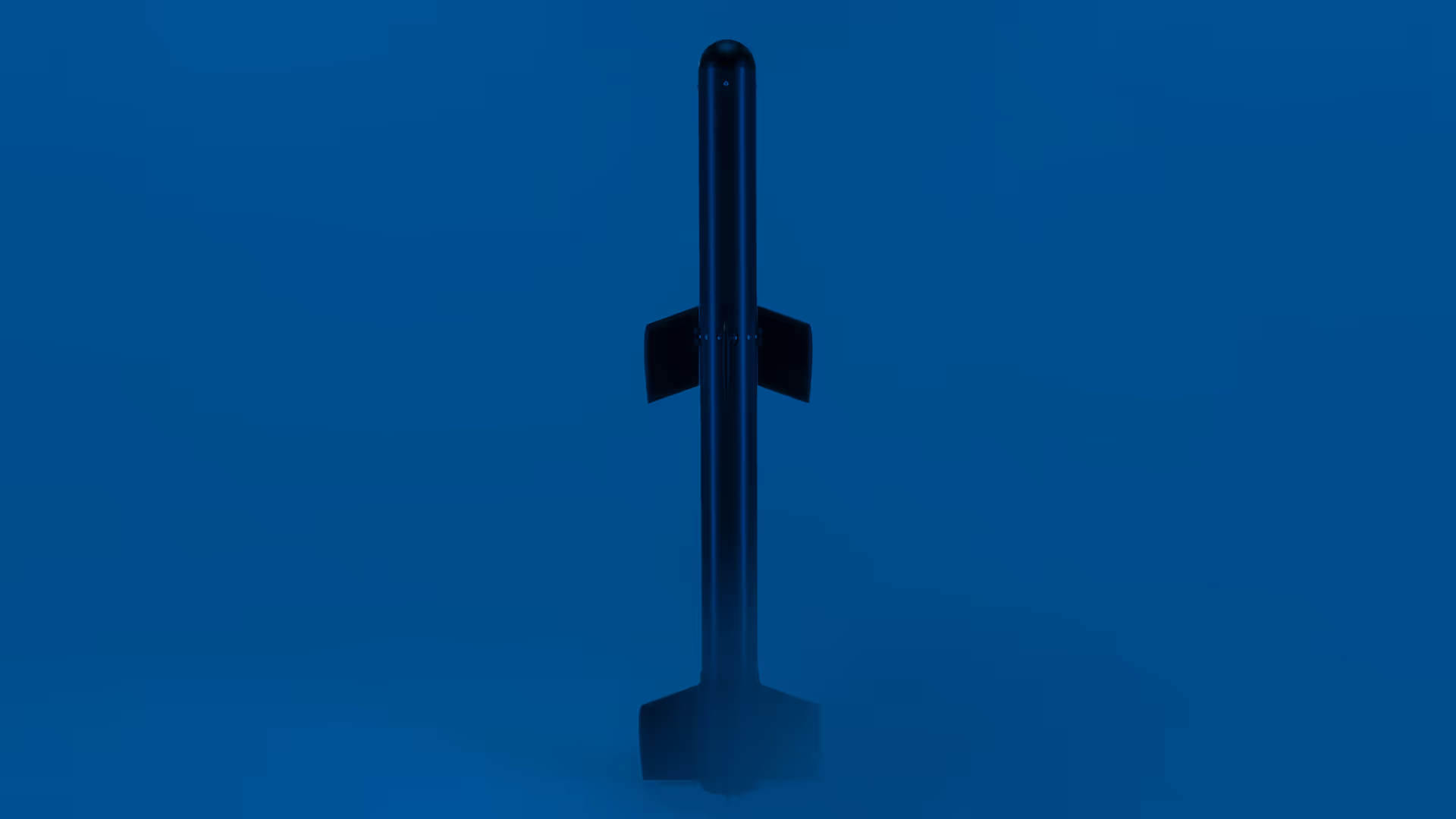
Scalable Defense for Unmanned Warfare
Unmanned systems are fundamentally changing how wars are fought. Mass-produced, one-way attack drones are overwhelming conventional air defenses and threatening critical assets: aircraft on runways, naval assets, command centers, and civilian infrastructure.
The Problem
Defending against low-cost suicide drones presents three critical challenges:
- RF jamming is becoming less effective. While radio frequency jamming has worked against current UAVs, next-generation systems are increasingly resistant or immune. A kinetic solution is required.
- Existing systems can’t handle swarms. Many kinetic systems in-use today—guns and lasers—engage one drone at a time and are quickly overwhelmed by large volleys.
- Cost and performance do not scale. Most kinetic systems struggle to defeat fast, maneuverable drones at a unit cost lower than the threat itself.
The solution must be kinetic, swarm-capable, high-performance, and cheaper than the threat it counters.
Introducing Dart
Dart is our answer to that problem.
We developed Dart by simulating against all known assets of adversarial nation-states. The result is a surface-to-air missile designed for high-volume deployment. Dart is vertically integrated to minimize cost while optimizing performance. Its custom radar is purpose-built for this threat and costs orders of magnitude less than legacy systems. Dart is architected for production at the scale of millions over the coming years, with a modular design that allows rapid iteration as adversarial threats evolve.
The Importance of Drone Defense
Technology has changed fundamentally over the last decade. For the first time in history, weapons can control themselves. Instead of requiring pilots, these aircraft rely on small electronics to achieve autonomy. As a result, strikes can be conducted with hundreds of thousands of UAVs.
Legacy systems are entirely unprepared for this future. While such strikes have so far been confined largely to short-range tactical use, it is undeniable that they will extend over time to longer ranges and higher precision against strategic targets.
A world in which the West cannot prevent drones from striking infrastructure, manufacturing capacity, logistics hubs, or key leadership is a world unprepared for modern conflict—and that world is fast approaching.
We must develop the ability to intercept drones at scale. We cannot allow low-sophistication adversaries to deploy thousands of low-cost weapons capable of crippling military or civilian infrastructure. Current air-defense systems are designed to counter relatively small numbers of sophisticated assets and will be completely overwhelmed by this new class of weapons. Air defense must be rebuilt for the realities of unmanned warfare.
Our Approach
Dart is a terminal interceptor designed for deployment directly at the asset under threat. It mounts flexibly to launch stations, vehicles, or fixed structures, and scales from single units to hundreds depending on threat density.
Dart’s ground radar detects incoming UAVs, and interceptors launch to neutralize them during approach. While layered defense is required for comprehensive protection, Dart addresses the most critical layer: kinetic interception at a cost lower than the threat itself.
We are refining the system throughout this year ahead of operational testing, and we are designing for manufacturing volumes in the millions—the scale unmanned warfare will demand.
Timeline: Development began mid-2024. Dart is currently flying. We are targeting in-theater intercepts by 2026.
The Future
Mach Industries will continue to set the pace in unmanned warfare, ensuring that—both offensively and defensively—the West retains a decisive advantage. We will develop multiple variants of Dart and its radar to address the full spectrum of unmanned threats, and we will ensure that the American warfighter and civilian population are protected from the growing danger of drone strikes.